M.Sc. thesis · MARUM & MPI Bremen & BIOM · 2026

How bacteria decide the fate of ocean carbon.

Some marine bacteria broadcast their enzymes into the water. Others stay attached and dig in. That single difference changes how much carbon the ocean buries.

Osman Can Kandemiroglu

University of Bremen · Faculty of Geosciences (FB5) · Hehemann Group, MPI Marine Microbiology & MARUM

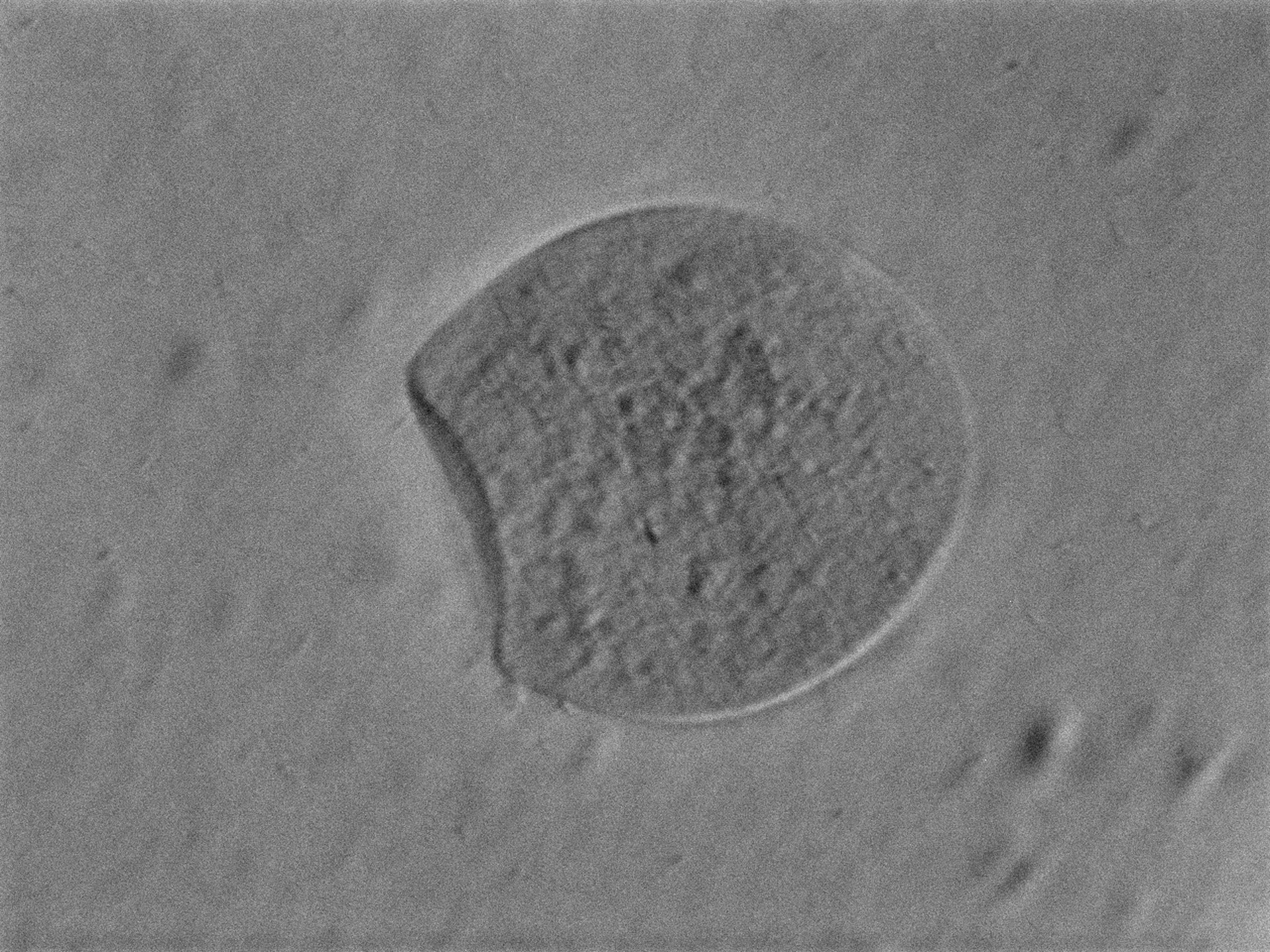
Phase-contrast micrograph of a single alginate particle being degraded by Vibrio cyclitrophicus ZF270 at 40× magnification.
The alginate particle was degraded by the marine Vibrio strain V. cyclitrophicus ZF270. 40× magnification.

Abstract

Why does organic matter resist degradation in the ocean? The biological carbon pump moves 4–10 gigatonnes of carbon into the deep sea every year, yet only about 1% reaches the seafloor — the rest is intercepted and remineralised by particle-attached bacteria. The standard explanation has been chemical: some polymers are simply harder for microbes to cleave. This thesis tests a complementary, ecological explanation: that the bottleneck sits in the microbial behaviour on the particle surface, not only in the chemistry of the polymer.

Six marine Vibrio strains spanning the broadcaster–aggregator enzyme-secretion spectrum were tracked degrading calcium-alginate gel particles (20–650 µm) across five experiments (ADE I–V), under controlled phosphate, ammonia and amino-acid gradients, alone and in mixed communities. Phosphate limitation and community assembly emerge as two independent buffers: each, on its own, can collapse the broadcaster degradation advantage and allow a fraction of particulate organic carbon to escape remineralisation. The trait that maximises individual bacterial fitness also minimises deep-ocean carbon export.

Keywords Marine carbon pump · alginate · Vibrio · enzyme secretion · broadcasters vs. aggregators · polysaccharide degradation · phosphate

First, the particles.

Before any biology, the experiment needed a substrate. Marine snow — the sinking particles the biological carbon pump depends on — is messy, variable and impossible to control in the laboratory. The model used here is a calcium-alginate gel bead: synthesised by emulsifying alginate with calcium carbonate in mineral oil, then triggering internal gelation with acid. The result is a sphere the size of natural marine snow, with a known polymer composition and a known degradation enzymology.

Getting these particles consistent took work. Thirteen synthesis experiments were run; three of those batches met the size, sphericity and stability criteria and were used downstream. Particles in the 20–650 µm range were size-sorted by sequential wet sieving (200, 100, 50, 20 µm meshes). The image below shows four representative particles from one of the qualified batches, captured at 10× under phase-contrast microscopy with line-tool diameter measurements. Across the full ADE I–V campaign, more than 1,600 particles were tracked by time-lapse imaging.

Synthesis runs
13 → 3
Size range
20–650 µm
Particles measured
302
> 100 µm by volume
91.3%
Fig. 1. The substrate, sized. Phase-contrast micrograph (10×) of four representative calcium-alginate particles from a qualified batch, with line-tool diameter measurements spanning roughly 98–255 µm. Click the image to enlarge.

Alginate degradation by marine Vibrio bacteria — watch it happen.

Time-lapse microscopy turns the slow chemistry of polysaccharide degradation into something you can see: bacteria colonise a particle, and over hours to days the alginate is enzymatically cleaved and the sphere shrinks. The clip below shows that process directly.

Alginate Degradation by Marine Vibrio Bacteria. Time-lapse microscopy of a single calcium-alginate particle under attack by a marine Vibrio strain — one of the > 1,600 particles tracked across the five alginate-degradation experiments (ADE I–V).

The central question

Why does organic matter resist degradation in the ocean? This is the question posed by the CONCENTRATE programme (DFG TRR 420) and the one this thesis is built around. The biological carbon pump exports 4–10 Gt C yr⁻¹ to depth, but only about 1% of the carbon fixed by surface photosynthesis ever reaches the seafloor — the rest is remineralised by bacteria on sinking particles. The standard explanation has been chemical: some polymers are intrinsically harder to break down. This thesis tests a different explanation — that the bottleneck sits in the microbial ecology of the particle surface.

Two enzyme-secretion strategies dominate marine polysaccharide- degrading bacteria. Broadcasters release their alginate-degrading enzymes into the surrounding water — fast, but wasteful. Aggregators keep the same enzymes tethered to the cell surface — slower, but more efficient at capturing the products. Under what conditions does each strategy win, and how does the answer shape the fraction of particulate organic carbon that survives the trip to depth?

The model system

Calcium-alginate gel particles, 50–650 µm across, stand in for sinking marine snow. Six Vibrio strains were filmed degrading them over 8–25 days using time-lapse microscopy, across five experiments (ADE I–V).

Particles
50–650 µm
Strains
6 × Vibrio
Experiments
ADE I–V
Imaging
8–25 days · time-lapse

The molecular tool that does the cutting is a PL7 alginate lyase. Below, the crystal structure of one such enzyme — drag to rotate, scroll to zoom.

Fig. 2. Crystal structure of a PL7 alginate lyase (PDB 2ZAB) — the molecular tool that cleaves alginate. Cartoon coloured by secondary structure; catalytic residues highlighted. Drag to rotate, scroll to zoom.

Broadcasters are faster.

When alginate is the only food available, broadcaster strains degrade roughly 1.6× faster than aggregators. The broadcaster 13B01 removed about 75% of a particle's volume in 8 days.

"78% vs 50% — secretion strategy, not species, predicts who degrades fastest."
Fig. 3. Broadcaster 13B01 reduces a single alginate particle to about a quarter of its starting volume over 8 days. Animates on scroll.
Fig. 4. Across all six strains, secretion strategy sorts the outcomes — broadcasters cluster above the line, aggregators below.

Phosphate is the switch.

The broadcaster advantage is not fixed. At 0.2 mM phosphate it is large — 82.5% vs 39.3% volume reduction. Remove phosphate entirely, and the advantage disappears — both phenotypes converge.

"Phosphate doesn't just feed the bacteria — it decides whether their strategy matters."
Fig. 5. Degradation across the phosphate gradient. The broadcaster–aggregator gap opens and closes as phosphate changes.

Phosphate is uniquely the switch.

Nitrogen and amino acids were tested the same way. Both boosted growth — but neither closed or opened the broadcaster gap. Only phosphate does. That makes phosphate a specific metabolic control, not a generic nutrient effect.

Communities buffer the difference.

In mixed co-cultures the picture changes again. The 2.2× monoculture advantage between two broadcaster strains collapses to 1.05× when other strains are present. The benefit traces to one specific gene — PL7G — not to the broad "broadcaster" label. All eight co-culture combinations degraded more than expected: cooperation, not competition, dominates.

Fig. 6. Co-culture composition and phosphate availability jointly set degradation efficiency.

The broadcaster paradox.

Here is the twist. Faster is not better for carbon storage. Broadcasters degrade particles quickly near the surface — which means the carbon is released as CO₂ before it can sink. Aggregators are slower, but can fully dissolve particles deeper down.

A simple settling model predicts that broadcaster-colonised particles retain only ~11% of their carbon at 1000 m, versus ~17% for aggregator-colonised particles. Bacterial fitness and carbon sequestration pull in opposite directions.

"What's good for the bacterium is bad for the climate."
Fig. 7. The settling model — degradation phenotype shapes particle sinking, and through it the carbon flux with depth.

Conclusion

The question posed by CONCENTRATE — why does organic matter resist degradation in marine environments? — finds a partial answer in the data presented here: phosphate limitation and community buffering together constrain bacterial degradation efficiency, allowing a fraction of particulate organic carbon to escape remineralisation and reach the deep ocean.

Built on

  1. Alcolombri et al. (2021). Sinking enhances the degradation of organic particles by marine bacteria. Nature Geoscience.
  2. Hehemann et al. (2016). Adaptive radiation by waves of gene transfer leads to fine-scale resource partitioning. Nature Communications.
  3. Badur et al. (2017). Fine-scale genetic and physiological variation reveals unknown enzyme functions. Journal of Biological Chemistry.
  4. D'Souza et al. (2023). Cell aggregation is associated with enzyme secretion strategies. ISME Journal.
  5. Enke et al. (2019). Modular assembly of polysaccharide-degrading marine microbial communities. Current Biology.
  6. Xu et al. (2026). Phosphate deprivation restricts bacterial degradation of fucoidan. Nature Microbiology.