Between 8.5 and 8.0 thousand years ago, the Black Sea passed from a freshwater lake to a marine basin. The exact pacing of that change — sudden flood or gradual transgression — has been debated for decades.
This work uses 35 verified lipid biomarker structures, drawn from archaeal, bacterial, and eukaryotic producers, to track the limnic-to-marine signal across the chemocline rebuild. Multiple proxies converge on the same temporal pattern, and the molecular evidence supports a gradual transition rather than a catastrophic flooding event.
The 8.5–8.0 ka record reads from two sediment cores recovered by R/V Meteor cruise M51/4 on the northwestern Black Sea shelf.
GeoB 7608-1 (1202 m, southeast) and GeoB 7609-1 (941 m, northwest) sit ~7 km apart on the same continental slope. The paired bathymetry lets us cross-check the limnic-to-marine signal at two depths and rule out site-specific artefacts. Click the map to explore — the interactive viewer shows GEBCO 2024 bathymetry, the river systems draining into the basin, and the exact core positions.
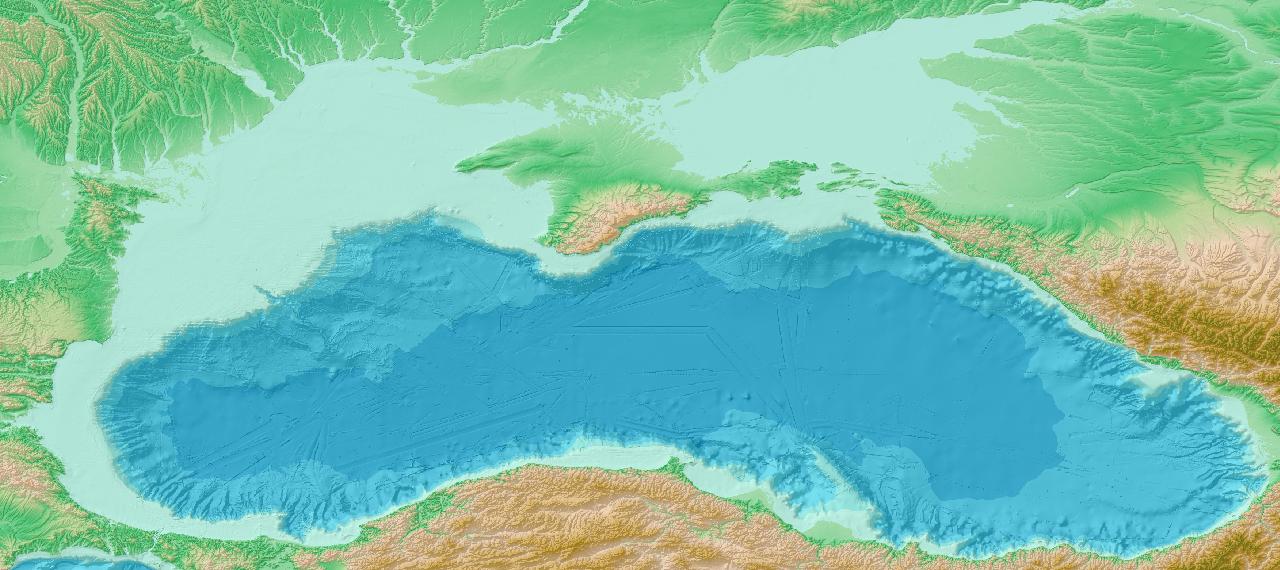
The deeper site captures the fully anoxic euxinic basin signature once the marine inflow established stratification.
Search data on PANGAEAThe shallower site sits closer to the chemocline excursion zone and records the transition with greater temporal resolution.
Search data on PANGAEABoth cores were recovered during R/V Meteor cruise M51/4 along the NW Black Sea continental slope. The site pair was chosen to bracket the transition zone where the modern chemocline excursion preserves the molecular record of the basin's 8.5–8.0 ka reorganisation.
Every biomarker on this page traces back to a primary paper read at full text — structure, producer organism, and proxy meaning.
The Black Sea 8.5–8.0 ka transition is reconstructed from lipid biomarkers preserved in sediment. Below: each major family, its source organism, what it measures, and a verbatim line from the paper that established it.
Four membrane-spanning archaeal tetraethers with 0–3 cyclopentane rings. Ring count rises with growth temperature — the foundation of the most widely used molecular SST proxy.
“A significant linear correlation (r² = 0.92) is found between the number of cyclopentane rings in sedimentary membrane lipids derived from marine crenarchaeota and the annual mean sea surface temperatures.” — Schouten et al. 2002, EPSL 204, 265–274 (TEX₈₆ origin paper)
A 66-membered macrocycle with 22 stereocenters and a cyclohexane–cyclopentane motif found nowhere else in nature. The diagnostic biomarker for all ammonia-oxidizing archaea (AOA).
“‘Ca. N. gargensis’ is the first cultivated archaeon to synthesize substantial amounts of the crenarchaeol regioisomer … supports the hypothesis that crenarchaeol is specific to all AOA.” — Pitcher et al. 2010, ISME J 4, 542–552
“We propose a revised structure of crenarchaeol, wherein the stereochemistry of the all-carbon quaternary stereocenter [A15′] is inverted compared to the original proposal.” — Holzheimer et al. 2021, Angew. Chem. Int. Ed. 60, 17504–17513 (first total synthesis)
Bacterial tetraethers built on a linear C₃₀ backbone with syn-positioned methyl branches and 1,3-trans cyclopentane rings. Methylation rises in cold, acid soils — the MBT′₅ME thermometer.
“Solibacter usitatus makes a large portion of its cellular membrane (24 ± 9% across all experiments) out of a structurally diverse set of tetraethers including the common brGDGTs Ia, IIa, IIIa, Ib, and IIb.” — Halamka et al. 2023, Geobiology 21, 102–118 (first axenic brGDGT culture)
“Herein, we report the first total synthesis of brGDGT Ia, thereby elucidating the relative configuration of the methyl branches as syn.” — Mahapatra et al. 2025, Chem. Eur. J. e202500702
Until 2013, 5-methyl and 6-methyl brGDGT isomers co-eluted on standard LC. Separation revealed the 6-methyl family preferentially abundant in alkaline, dry, arid soils — and a distinct climate proxy.
“Identification of novel penta- and hexamethylated branched glycerol dialkyl glycerol tetraethers in peat using HPLC-MS², GC-MS and GC-SMB-MS.” — De Jonge et al. 2013, OG 54, 78–82
Marine isoprenoidal GDGTs with a tertiary hydroxyl on the biphytane backbone. Enriched in cold and polar waters — and the producer was a 12-year mystery solved only in 2024.
“Nitrosopumilus adriaticus NF5 shows a substantially higher relative abundance of OH-isoGDGTs (~49%) compared to Nitrosopumilus piranensis D3C (~5%).” — Varma et al. 2024, Biogeosciences 21 (first axenic OH-isoGDGT culture)
Long-chain ketones from haptophyte algae give the classic UK′₃₇ thermometer. But the Black Sea inverts the standard story — and the manuscript engages with that directly.
“Haptophytes related to brackish Isochrysis spp. were the initial sources of alkenones, and appeared immediately after the onset of sapropel deposition (~7550 yrs before present). E. huxleyi colonized the Black Sea shortly after, ~4000 yrs earlier than previously recognized.” — Coolen et al. 2009, EPSL 284, 610–621
Reading the primary literature carefully — not the textbook summary — surfaces ten caveats that shape how every claim above is interpreted. Below: the ones that matter most for the 8.5–8.0 ka window.
3D viewer · click any structure to expand · ball-and-stick / line / surface views
TEX₈₆ · BIT · MBT'5ME · Methane Index · UK'₃₇ — what each measures, how they triangulate the transition.
Unit IIa sapropel and the chemocline rebuilding — depth, age, lithology, and the visual moment the basin turned.
A geological timeline locating this window inside the Holocene.
Verified BibTeX, build scripts, peer-review records, lab notebook — all open.
Scientific comments, corrections, and collaboration enquiries are very welcome. Please reach out by email — feedback on biomarker assignments, taxonomy, or proxy interpretation is especially appreciated.